
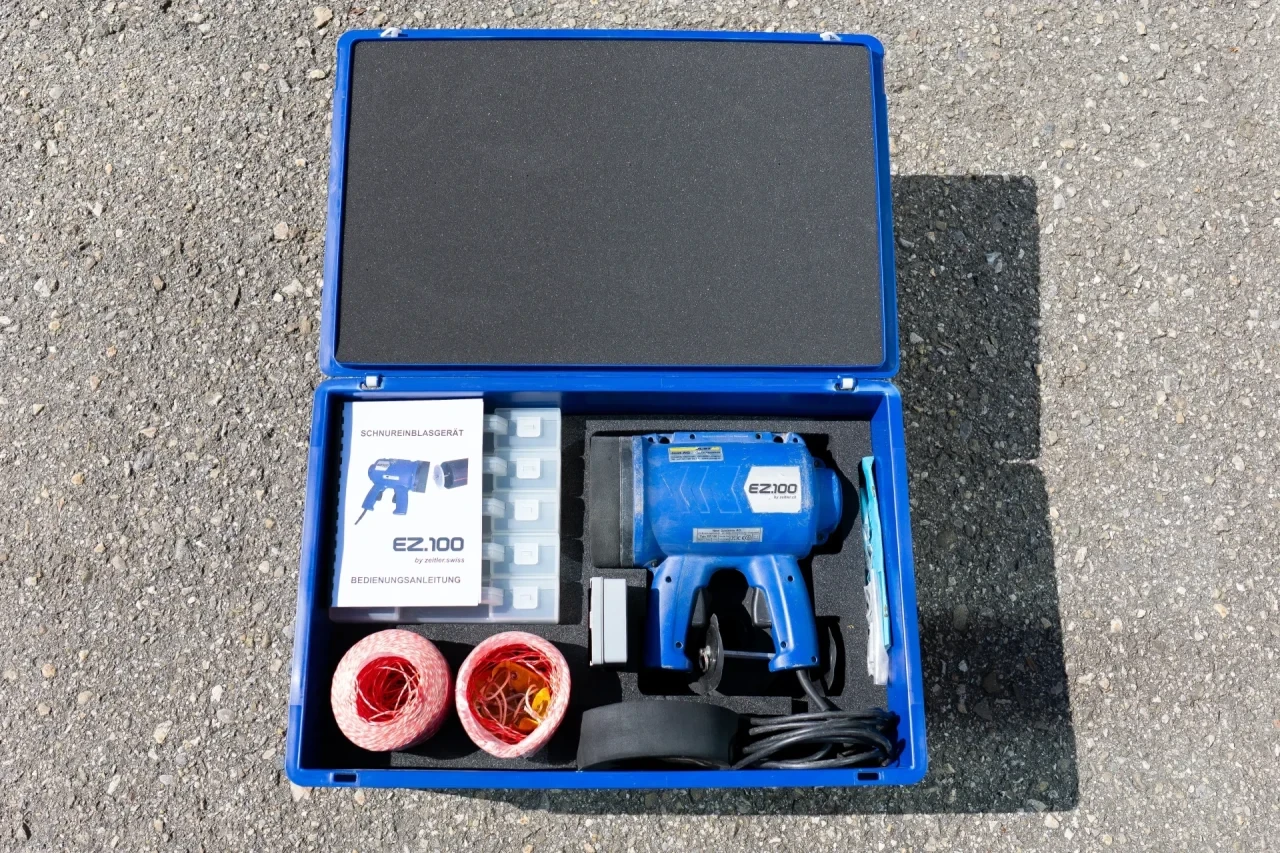
Cord blowing-in device EZ 15 / 50 / 100 / 300
From microtubes to cable protection tubes – four models.
Cord blowing-in devices handle the first step of any cable installation in pre-installed conduits: a pull string is blown through the tube using compressed air; it later pulls in the guide rope, which in turn pulls in the cable. Jost Ltd. offers four devices in a range of pipe sizes – from the EZ 15 for micro-pipes in building connections to the EZ 300, a battery-powered all-rounder for outdoor civil engineering. The comparison below shows which model is best suited for your specific task.
Which model is best suited for what?
EZ 15 – Microtubes in the service connection
The smallest device in the series, designed for shorter distances from the distribution box to the house or room.
The only model without a built-in drive: It runs on a standard compressor and is protected by safety couplings and overpressure protection. The top choice for fiber-optic home connections and interior installations, where distances are short and pipes are small.
EZ 50 – Electrical and flexible tubes for interior construction
The next step in tube sizing for interior construction in residential, commercial, and industrial buildings.
Self-driven; no external compressor required. Where the EZ 15 reaches its pipe-size limit, the EZ 50 handles electrical and flexible conduits.
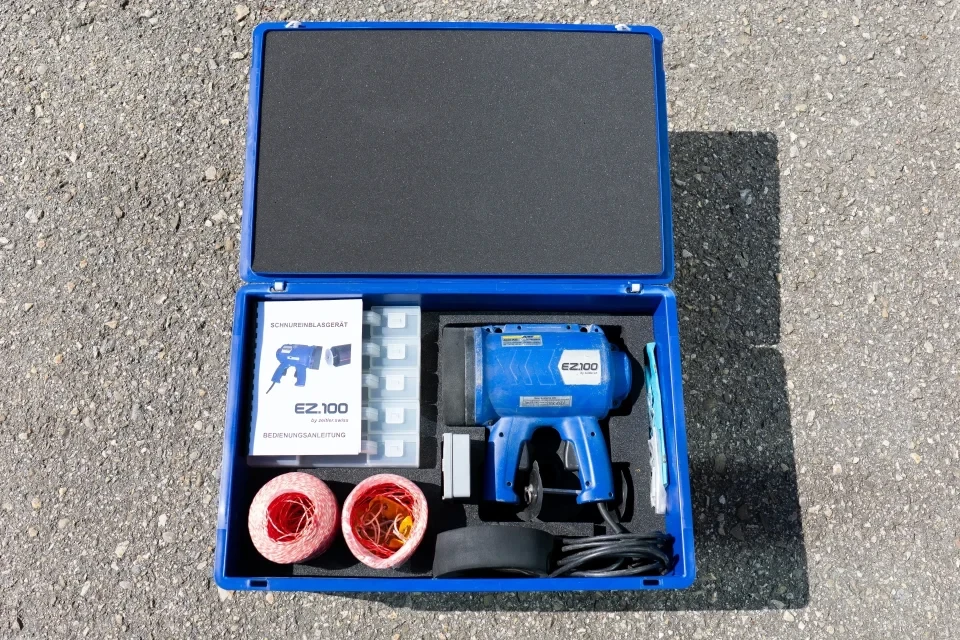
EZ 100 – Cable protection tubes for civil engineering
The equipment for civil engineering – cable protection tubes, with pull-in lengths well over 1,000 meters.
The top choice when the condition of existing pipes is unknown: The EZ 100 prepares the pipe in the same step in which it pulls the cord through.
EZ 300 – A battery-powered all-rounder
The battery-powered all-rounder with a 2-stroke engine.
The widest tube span and the broadest range of applications in the series – from residential construction to road, tunnel, bridge, and mountain railway construction, wherever electricity is not available.
A comparison of the four models
| Model | Inner tube diameter | drive | Feed length | Cord tensile strength | Typical application |
|---|---|---|---|---|---|
| Room 15 | 4–20 mm (microtubes) | Standard compressor, 200–300 l/min (not included) | 500 m in 30 seconds | – | Fiber-optic home connection, interior work |
| EZ 50 | 18–50 mm (electrical and flexible tubes) | built-in, without a compressor | several hundred meters | – | Electrical and flexible tubes for interior finishing |
| EZ 100 | 50–150 mm (25 mm and up with special accessories) | built-in, without a compressor | over 1,000 m (record: 3,280 m) | up to 300 kg | Civil engineering, roads, tunnels, bridges |
| EZ 300 | 25–200 mm | 2-stroke engine, battery-powered | over 1,000 m (record: 2,850 m) | up to 300 kg | Outdoor all-rounder, from residential to tunnel construction |
Your benefits at a glance
- Compact design – All four models fit in any car trunk; no flatbed truck or special transport is needed to reach the construction site.
- Accessible even in the tightest spaces – manholes, narrow corridors, low ceilings: These devices operate where stationary systems cannot reach.
- Ready for use in no time – Easy to operate, no special training required for each use; one person is sufficient for transport and operation.
- Dual-function blowing or suction (EZ 50, EZ 100, EZ 300) – If you encounter problems pulling the cord through or if the tubes are clogged, you can also use the suction function without having to reverse the process.
- Cleaning, calibration, and cable pulling in a single operation (EZ 100, EZ 300) – For tubes in poor condition, cleaning, flushing out water, calibration, and cable pulling are all performed in a single operation.
Features
All four models are compact, single-operator units with identical operating logic—once you’re familiar with one, you can operate the others without having to relearn anything. Connection to the compressed air source – an external compressor for the EZ 15, an integrated drive for the EZ 50/100/300 – is made via quick-connect couplings, ready for use in just a few minutes.
Advice and next steps
During the technical consultation, Jost determines which of the four models is best suited for the pipe size, distance, and installation site. During the installation process, the following steps follow the pre-roping: the MRE 3.5 mechanical crawler pulling device as an alternative for fiber optics, the cable pull machines (KZW) for the subsequent pull, and the CP 200 for thrust support.